


The Ultimate Project: Inside the Season of the 2024-25 Ashoka Hammerheads
“DEFENCE… ready?”
Match point, the National College Ultimate Championships. The bronze medal, and a first national-level honour in half a decade, within reach for the Hammerheads.
“OFFENCE… ready?”
Ashoka University’s marquee ultimate frisbee team hasn't won at the NCUC since its inaugural edition in 2018. Seven of their best players graduated last year. This is a new core. Young, hungry, and competitive. They’ve already made history. But not enough.
“PLAY!”
Ten seconds, and a blur of runs and throws later, it’s all over. A moment of silence, then jubilation.
Ashoka Hammerheads 13, MTB College of the Arts 9.
They’re winners. Indian third seeds. Equals among the best of the best.
Beating the odds, breaking records, and most crucially, creating a welcoming and healthy team environment, saw the Hammerheads rebuild their spine with great success. New gems were unearthed, rookie talents were nurtured into rising stars, and three medals in six months to boot culminated in their bronze triumph at the NCUC.
This is the story of their rebuild, from Edict Sports writers Aneek Chatterjee and Yashwanth Reddy.

***
The frisbee field is at the heart of the Ashoka University campus. It’s a crying shame the eponymous team largely hasn’t been. “Frisbee is a very unique sport in India. It's also not very well perceived in Ashoka. It's often not considered a sport entirely,” reflects one member of the community.
To the layman, Frisbee is a game you can play on a Nintendo console. The existence of Ultimate Frisbee as an internationally recognised, regulated and competitive sport is news to most incoming students at Ashoka University. The lack of widespread licensing and broadcasting agreements for national- and international-level frisbee tournaments prevents the sport from reaching a generation that has grown accustomed to watching cricket and football on their screens. The unfortunate reality, thus, is that Frisbee’s place in the hierarchy of sports is lower. It is rare to find a freshman who has played frisbee before college, let alone competitively. That common level of amateurism proves to be a blessing in disguise, creating a level playing field for all new enthusiasts. Couple that with a training setup designed to provide individual attention and technical education, and any dedicated athlete can very quickly learn how to master control of the disc.
Ashoka University contracts coaches for its frisbee team from a third-party organisation, Y-Ultimate. These coaches are current India internationals Megha Rawat, Laxman Rai, and Ankit Lakra. In August 2024, all three coaches were selected to represent India at the World Ultimate Championship in Australia, one of the biggest tournaments in the world. What was a moment of great prestige and honour for them, also unfortunately dealt a heavy setback to the Ashoka Frisbee team, who were forced to begin their season with no coaches available. Hot on the heels of the graduation of seven seniors (the equivalent of an entire starting lineup), it left co-captains Aarya Toshniwal and Varun Bahl with a heavy burden. Both took up new, unfamiliar roles as player-coaches.
The situation the team found itself in was dire, but unexpected surprises proved to be the theme of the rebuild. The captains became player-coaches, and players who had made their competitive debuts mere months prior were now involved in teaching new inductees. Second-year UG27s like Akil Ravichandran, Arnav Mayur, Tanishk Ginoria, Shivom Srivastava and Yashwanth Reddy took greater seniority in training sessions, providing able support to the veteran core of the team that included Prisha Visveswaran, Narendra Chatta and Rutuja Chavan. “We lost star players, so we built new stars,” sums up captain Toshniwal.
Frisbee is among the best examples of a team sport in which the whole is greater than the sum of its parts. Individually skilled players can raise the ceiling of a team, but a team’s primary strength comes from efficient and precise movement, built on trust and good communication. In effect, the potential is immense for managerial strategy and good training to transform a team from rank-fillers to title challengers.
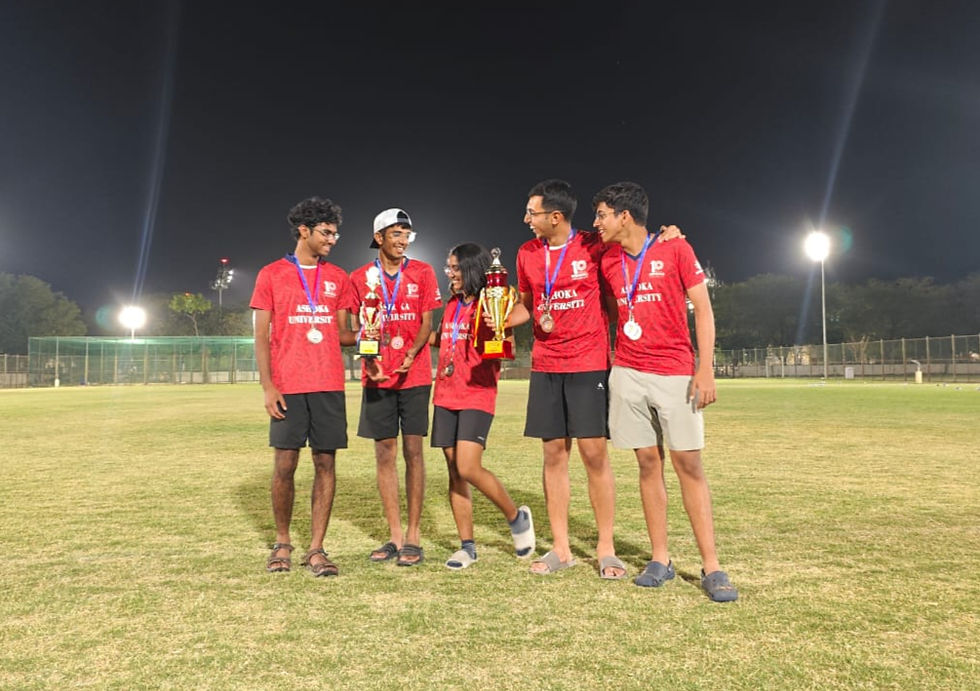
The first test for this new-look side was at IIT Kanpur. It was trial by fire for the inexperienced team, barely half of whom had ever participated in a tournament before. The nerves showed. Despite a promising run to the final, the Hammerheads got… hammered, for lack of a better word. The scoreboard read 15-5, and Bahl was left fuming. “Absolutely horrible” was his verdict, despite the consolatory silver medal. “Sure, we came second in the tournament… but that does not take away from how we played [especially in the final].”
The tournament offered a first reality check for the rising juniors. It was a necessary step for the squad to take, especially in terms of ironing out in-play issues and tactical confusion. “It was a good learning opportunity… I think that drumming was necessary for us. It made us a better team from where we were,” reflects Bahl. The underdog run at Kanpur would prove to be a promising sign of things to come, but equally, it highlighted what was and wasn’t working. Team tactics evolved, and squad chemistry grew stronger with time spent together on and off the field. Injuries and fresh inductions saw a high turnover even within the new inductees. Ultimately, “a lot of people who went for that tournament did not travel for successive tournaments.” The result? “When we ended the season, I think the team [was] vastly different from what it was at Kanpur,” remarks Toshniwal.
Among the new inductees were UG28s Arya Gupta, Dheer Jhaveri and Saanchi Dhariwal, who joined the frisbee team in their first semester. Jhaveri, in particular, credits the team environment for their assimilation. “It wasn't easy to get accustomed to new surroundings, new people. But the frisbee team was so welcoming, so sweet, and so supportive, that it was hard not to get close to people,” he reflects.
Dhariwal’s experience playing a mixed-gender sport echoes that sentiment. “We treat everyone as an equal player. Every single opponent team has said, ‘You use your women players really well.’ That's a good thing, I think other teams also need to adopt that.” It’s not a question of trust between a cis-male and a non cis-male player, but rather, “blind player-to-player trust.” In a sport where players tend to mark rival players of the same gender, the Hammerheads’ NCM players regularly outshine their opponents in 1v1 matchups. Their technical and athletic talents earn them high respect as athletes and difference-makers. Tactical mastermind Toshniwal devised match-specific strategies that made the best use of the Hammerheads’ biggest advantage, while the brilliant play of Visveswaran, Chavan, Ravichandran and Poulomi Sarkar would end up being crucial to NCUC success.
Toshniwal was also responsible for the impressively quick development of Ravichandran. “It was challenging at the beginning of the year. There were moments I was not sure what I was suited for,” reflects the latter. “I think by the time the second semester came and we went for the BITS Hyderabad tournament, I was really feeling like, ‘Wow, okay, I can do this.”
***
“Okay, now we're doomed.”
The Spring ’25 semester, with all its promise, brought the heaviest of setbacks. Captain Toshniwal suffered an anterior cruciate ligament (ACL) tear, an injury that effectively ruled her out for the entire coming year. It was Toshniwal’s second ACL tear in successive years, and the prospect of yet another lengthy period on the sidelines was a difficult pill to swallow. “You're watching your peers play, you're watching them grow, and you're just stuck at the same place.” Crueller still was the timing: Toshniwal and her Hammerheads squad were readying themselves for the NCUC at BITS Pilani. “My mentality was changing… then again, suddenly it's 10 steps back.”
But Toshniwal is admired and revered for reasons beyond her technical skill. From the mental doldrums of coping with her injury, she rallied herself and her heartbroken teammates, taking direct managerial control of the team to give them the tactical push they needed. “We could see how much she wanted to play, but to be able to fight that, to be able to guide us so well, her mental determination was very impressive,” says Srivastava.
As the news of Toshniwal’s injury threatened to derail squad morale, the winter preseason camp in January 2025 proved to be transformative. “I think more than the practice in pre-season, it's the team bonding that is important,” says Bahl, whose stoic leadership and supportive arm-around-the-shoulder approach saw him host team dinners and take time out at late hours to provide his juniors with individual feedback. He recalls that period as the time “the team really started to feel like one unit.” With the NCUC on the horizon, team preparations moved up a gear. Bahl and Toshniwal (ever-present via video calls and WhatsApp texts) used the time to build training sessions around the team’s specific gaps. “Varun and I tried to create drills to focus on things that we were lacking in, and build that instead of doing the same routine every day,” explains Toshniwal. This attitude carried forward into the semester, with players running laps around campus, practising throws at odd hours, and meeting on Saturday mornings to work through set plays.
Before the ultimate battle at Pilani was a tournament at BITS Hyderabad — a final preparatory test that did not go well for the Ashoka Hammerheads, who lost by significant margins to both BITS Hyderabad and BITS Goa. Even so, Bahl credits the tournament with settling the uncertainty around the form the team would finally take. “Only in that particular tournament did I finally understand who was going to play on offence, who was playing on defence, [and] what our zone looked like.” Belief within the team was beginning to grow, and one game, against BITS Alumni, stood out from the rest. It was a dead-rubber game with no consequence to the final standings, and freed from performance pressure, the team finally clicked together. It was a great performance marked by a narrow loss that felt almost irrelevant.
The Hammerheads came out of the tournament with a fresh penchant for revenge, determined to take down the BITS teams when they met two months later at NCUC. It was at this time that Bahl and Toshniwal set their mind on a specific target, to achieve what Ashoka had failed to repeat since 2019 — a podium finish at NCUC. Bahl returned to his room after Hyderabad and turned to his whiteboard. “That’s when I wrote: NCUC #3.”

***
The annual National College Ultimate Championship is what every college frisbee team builds towards over the course of the season. “It is genuinely the biggest tournament for college teams in India. It's very competitive. You have to field your best squad; there is no other option,” says Toshniwal. Tournaments like IIT Kanpur and BITS Hyderabad can be geared towards learning and growth. But at the NCUC, it’s all about performance. And what a performance it was. “I felt a little bit like I was living in a movie,” recounts Ravichandran.
The Hammerheads began the tournament promisingly, winning 2 out of their 3 group-stage matches on the first day. Their sole loss came against MTB College of Arts, a team of heavyweights considered favourites for the top prize, with a devastating scoreline of 5-11.
In the quarterfinals, Ashoka were drawn against BITS Hyderabad. The team that had not just beaten them mere months ago, but had also eliminated the Hammerheads at this very stage the previous year. The deja vu was even more disorienting when the scores were tied at 7-7. Universe point, just like a year prior. The next point would be a do-or-die, winner-takes-all. This time, though, there was an almost divine light at the end of the tunnel, and redemption felt poetic. The ASP ’25 duo of Visveswaran and Chatta combined to score the winning point, with a handy involvement from one of these writers. “It just meant so much, we finally made it past that hurdle, broke that ceiling,” remembers Ginoria, who fell to the turf in tears of joy.
That joy would prove to be short-lived, as the Hammerheads were swiftly outmatched in the semifinals by eventual winners Azim Premji University. “The loss in the semifinal brought us down, grounded us a little more [to] sit and discuss what to do,” remembers Malhotra. Aspirations for a gold medal were dashed, but the bronze would not come easily either. Their third-place tie would be against MTB College of Arts.
Barely 24 hours had passed since Ashoka lost to the very same opposition, and the confidence that MTB drew from that fact showed from the start, leading to a 1-3 scoreline within the opening minutes of the game. A bold Toshniwal chose to implement a new strategy, one which required the non cis-men players to cover certain vital attacking zones, while the cis-men players stuck to their marks, switching with other defenders instantaneously as and when attacking players entered those zones.
The only catch? It had never been practised before. But such is the trust and coordination of this team, it worked. The Hammerheads played like a team transformed, choking the MTB offence, making interceptions and then securing the point with clockwork precision. Rinse and repeat. Having lost to this heavyweight of a team just twenty-four hours ago, Ashoka won the game 13-9, earning their bronze by a considerable margin.
Young Hammerheads, all shouts and screams, tears and smiles, battered bodies holding on to each other in sheer delirium, marking a winning moment they are sure to remember forever. Winners. Indian third seeds. Equals among the best of the best. “We went in not entirely believing in ourselves and came out completely believing in ourselves, which is a pretty sweet feeling,” smiles an exalted Ravichandran. In April 2025, at the annual Ashoka University Student Excellence Awards, she was named Most Valuable Player of the Year for the Frisbee Team, an honour she shared with captain Bahl.
“I think the high I got from playing in NCUC is something I'm going to be forever chasing.”
***
A sense of missed opportunity still pervades the Hammerheads' setup. After coming so close to the gold, they will look to challenge for the top prize again next year. New captains Akil Ravichandran and Arnav Mayur are relishing the task. Ravichandran is already thinking of new ways to raise the bar for the team. “Younger players work[ing] on an individual level and upskill[ing] with senior members, senior members to upskill themselves… just more games in general, bring a little more competitiveness.”
For Toshniwal and Bahl, the torch has been passed and the flame burns bright. Toshniwal is eying a return to play in time for NCUC’26, keen to lift the gold as a player after touching bronze as coach. As for Bahl, he simply wants to see the community continue to grow.
“Our senior team is called Hammerheads, but we represent much more. We represent Ashoka Ultimate, the culture of the community. The people who have come before and the people who will come after, it's all laying the groundwork for that. Sometimes people don't see it, just walk past it; people don't know it exists. It used to hurt earlier, but now it's become a challenge. It’s a mission for me to get more people into the sport.”


Please mention that you lost 13-4 to Azim Premji University! Also please refer to females as females and not non-cis men.