
No Party in the USA: The Spectacle and Scandal of the 2026 World Cup
Updated: Aug 31
“This sport belongs to the world.”
— Tom Cruise
On June 11, 2026, the world turned its eyes to the Estadio Azteca in sunny Mexico City to watch football’s biggest stage come to life as South Africa faced off against one-third of the hosts, Mexico, in the opening match of the FIFA Men’s World Cup. Thirty-eight days later, it watched as a youthful Spanish team rose to the occasion, beating a Lionel Messi-led Argentina to claim their second World Cup. Forty-eight teams came to North America with one vision and one mission, but to the victor belong the spoils, and none but Spain can claim them.
The footballing world’s reception of the World Cup’s expanded 48-team format was overwhelmingly positive. Many critics had pounced on this change, calling it ‘greed’ and arguing—with merit—that the highest authority was not caring for the wellness of its players. But, for fans and neutrals, it was delightful! Fans were treated to seventy-two games just in the group stage, four more than what we saw in the entirety of the 2022 World Cup, with the final between Spain and Argentina being Match 104. More qualification spots for Asian, African and American nations saw new fanbases energised and engaged, and the 2026 edition achieved the highest cumulative viewership of any World Cup in history (men’s or women’s), while also recording over $15 billion (!) in net revenue.
The World Cup began and ended with a bang, but amid the fireworks, it left a smokescreen of whispers in its wake—those of an unfortunate future. When the US, Mexico and Canada were given the opportunity to host the 2026 FIFA World Cup, football fans across the world breathed a sigh of relief. Long gone were the days of exploited migrants forced to work as slaves (Qatar, 2022) or worrying about how much it cost to host a tournament while millions face poverty (Brazil, 2014). No, this time it would be different—and it was! Restrictions on the movement of entire teams, strict policing and immigration checks of professional athletes, entire nations barred from even travelling (whose tickets, however, were interestingly non-refundable). All of these events force us to take a step back to question and criticise the organising bodies, urging us to ask a startling question—when we place restrictions on who plays the ‘world’s game’, does anyone?

Sportswashing
The last three editions of the World Cup have all been embroiled in allegations of sportwashing—the practice of authoritarian regimes using sports as a means to disguise, or distract from, the atrocities committed by them in their nations. None did it more successfully than Russia in 2018. The hosting rights had been granted in 2010, long before Russia's full-scale invasion of Ukraine in early 2022. But especially after the annexation of Crimea in 2014, British and American diplomats urged FIFA to reconsider allowing Russia to host the 2018 Cup, citing Yugoslavia’s previous restrictions as precedent. But these requests were categorically denied by Sepp Blatter, the sitting FIFA president, on account of Russia being “given and voted” the rights to host football’s biggest stage. It would be remiss to mention Blatter and not bring up his history of corruption as the head of FIFA—he resigned in 2015 after it came to light that he had accepted bribes and underhanded marketing rights agreements for votes to Russia and Qatar for their respective hosting rights, costing upwards of $150 million.
Qatar 2022 was thrust into the limelight when allegations of slave labour were floated in international media. Over 6000 migrant workers died during the construction of brand-new stadiums in the country; the Qatari Crown owned up to only 37. What happened to these stadiums after the World Cup, you ask? Well, most stadiums built specifically for the event were downscaled, repurposed, or completely dismantled, making football fans wonder what the need for so many ‘temporary’ stadiums was. Qatar’s draconian laws for the queer community, and its semi-draconian laws for women, were also criticised, with supporters and teams citing security issues for themselves and travelling support. Teams took their rebellion to the pitch; Germany, most prominently, covered their mouths during the pre-match photos, to protest against Qatar’s ban on “One Love” armbands promoting diversity and inclusion.
Most famous is the 1978 FIFA World Cup, held in Argentina and won by Argentina while conducted under extreme pressure by ruling dictator Jorge Rafael Videla. Videla used the guise of sporting merit and achievement to hide the brutal reality of politics (or the lack thereof) in the country. He even entered the dressing room of Peru before their match against Argentina and demanded they lose the match by a large margin so Argentina could qualify over neighbours and footballing rivals, Brazil. Peru lost that match 6-0, and the hosts went through as table-toppers. Four days later, as Mario Kempes lifted the revered World Cup trophy, thousands of Videla’s political opponents were kidnapped, tortured and executed, their bodies dumped in the ocean for no one to find.
One might notice the startling similarities between Videla’s Argentina, Putin’s Russia, the Emir’s Qatar, and Trump’s America—the latest host of the FIFA World Cup. Trump’s Republican Party regained power in 2024, and since then, has passed mandates on immigration, deportation, inclusivity, and general public safety that seem to be inspired by what can only be called fascism. The United States Immigration and Customs Enforcement (ICE) has been waging war on migrant workers across the country, setting up deportation centres for interrogation and incarceration. The Department of Defence (rechristened to the Department of War!), led by Secretary Pete Hegseth, rained fire on Iran, a country set to feature in the 2026 World Cup IN the US. Coupled with Trump's new anti-transgender policies, restrictions on healthcare access and rollback of discrimination protections, it all raised the question: was this the same United States of America that for centuries called itself the ‘land of the free’?
Sport by its very nature is political—a carrier and culmination of social and cultural motivations and aspirations. While previous perpetrators of sportswashing used the opportunity to host the World Cup/major sporting event to paint their country in a positive light, the 2026 World Cup has done the opposite for the US. Anti-sportswashing (or failed sportswashing) is an interesting stance to take, but it is backed by a series of visa rejections, security concerns, and ‘Americanisations’ that took over football’s biggest stage to scathing public dissatisfaction.
Immigration, Visas & Iran
On the eve of the World Cup, the US expanded their travel visa bans to 39 countries, including but not limited to World Cup participants Haiti, Côte d’Ivoire and Senegal. Athletes from these countries received visa waivers, allowing them to participate in the competition, but fans, extended family, and journalists were denied visas at all costs. High-profile incidents include Cabo Verde’s heroic goalkeeper Vozinha’s mother missing her country’s historic 0-0 draw against eventual champions Spain, and Omar Artan, CAF awardee for ‘Best African Referee 2025’, being denied entry to the United States on ‘suspected terror links’ Al Jazeera.
When teams landed on American soil, they were subjected to strict immigration checks. Senegal, for instance, went through multiple layers of security checks involving sniffer dogs, frisking, and invasive bag searches. Iraqi star Aymen Hussein was detained for several hours upon his arrival at Chicago before being allowed entry, while other members of their press team were detained before being denied entry altogether. Fans were quick to notice a pattern emerging in the nations subjected to such checks—they were all African and Middle Eastern. The White House denied all allegations of racial profiling.
Iran had it the worst. At war with the US since February 2026, with attacks continuing throughout the World Cup and even after it, Iran were threatened by disqualification multiple times in the build-up to the tournament. Baseless, yes, but the possibility of them travelling to the tournament and not being allowed onto American soil was real. These fears were eventually assuaged, and participation allowed, but the Iranian delegation was not permitted to establish their training base in the US. They would only be allowed into the US to play their matches, with American officials citing logistical and security concerns as the driving factor behind this decision. Their camp was moved to Tijuana, Mexico, forcing the team to travel to Los Angeles and Seattle just a day or two before their matches and leave the country immediately after, leaving players no time to rest.

Why were Iran’s matches not shifted to Canada or Mexico, countries willing to host these matches? Simple— money. The US houses over 1 million Iranian nationals, while Canada and Mexico together are home to less than 300,000. If games had been shifted to either of the latter countries, it would have been much more difficult for Iranians on the continent to show up and support their team. And if a large number of these fans managed to get flight and stadium tickets, the money would have headed out of the American economy into that of their neighbours. So, to keep American money in fewer American pockets, FIFA and the White House decided to stick to the original venues for Iran’s matches, even if that meant forcing the team into harsh travel arrangements, travelling hundreds of miles just to play a game of football.
FIFA, suspecting visa-based discrimination before Russia 2018, made it explicitly clear that host countries must process visa requests in a non-discriminatory manner through FIFA’s Fan ID visa system. Why was this system absent during this World Cup? Why did the US create a separate, dedicated department for visa requests for the tournament? Why must all fans have a valid US visitor visa—one notoriously time-consuming to obtain even without the demand driven by a global showpiece competition—to support their country?
Donald & Gianni: An American Love Story
Gianni Infantino, the sitting president of FIFA, has long shown a tendency to bend over backwards for people in power—his admiration for Russian president Putin is well documented—but his flexibility reached incredible lengths when he began his professional relationship with President Donald Trump. The two have been seen on multiple occasions, sharing meals and spending quality time together.
Infantino’s ingratiation with Trump began in 2020 during a visit to the White House, where he declared the US president a “sportsman” who “says actually what many think”. Before the 2025 FIFA Club World Cup, an international tournament featuring club teams including Real Madrid, Paris Saint-Germain, and Flamengo, Infantino presented Trump with the Club World Cup trophy, now kept fondly in the Oval Office. The same year, Trump was also the first awardee of the FIFA Peace Prize for his ‘efforts in promoting global unity’. And interestingly, Infantino also rented out a floor in the Trump Tower as “office space” for FIFA, which sits all but empty and idle a year into its occupation. Now, as Infantino’s term as FIFA President comes to a close, reports are suggesting that Trump might nominate the Swiss national for the post of UN Secretary-General, making it somewhat clearer why Infantino had been buttering up his American counterpart so much.
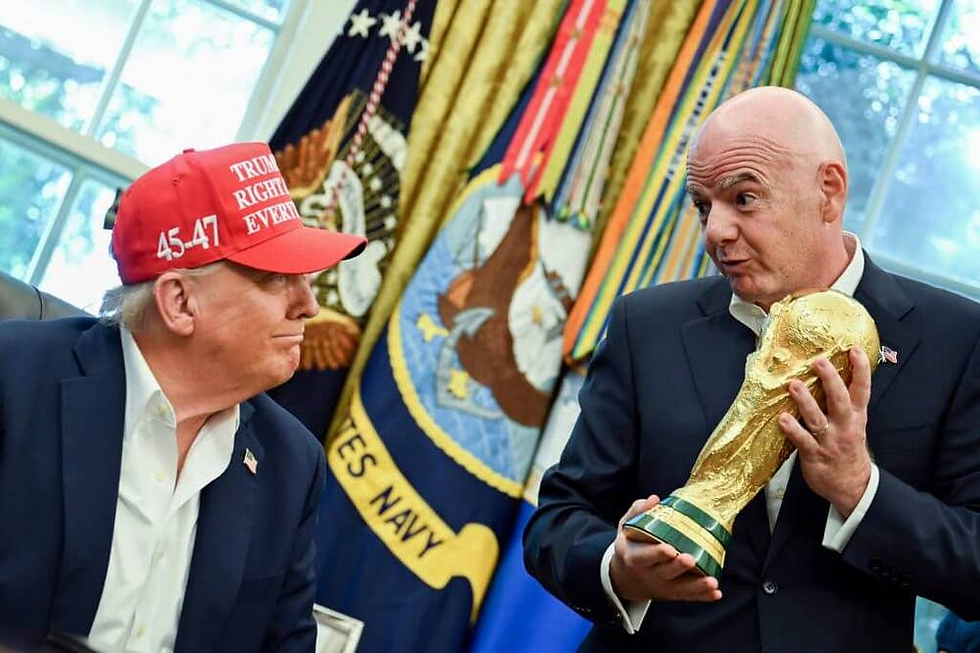
As is the case with most ‘professional’ relationships, Infantino cannot get himself to say ‘no’ to Trump. Trump wants to keep a replica of the CWC trophy: yes, he can! Trump wants to lift the CWC trophy with Chelsea and join them in their celebrations: of course, why even ask? Trump wants to hold the official World Cup trophy, breaking a decades-long policy prohibiting non-winners from handling the cup: of course, and do it right next to me (Infantino). Trump wants to prohibit the Iranian team from staying in ‘his’ country: send them to Mexico! Trump wants to have broadcasting breaks disguised as hydration breaks to get more money: hell yeah! Trump wants to have a 30-minute-long half-time show: not my players, not my problem, bring it on!
These ‘Americanisations’—a term coined by social media users to highlight when US customs and traditions are imposed on non-US-centric sports/countries—heaped immense pressure on FIFA to uphold the novelty of the world’s game, while evidently being unable to cope with Trump’s demands, because Trump and his administration refused to understand when they were wrong. When Trump demanded FIFA rescind and overturn Folarin Balogun’s red card against Bosnia and Herzegovina, FIFA obliged, showing how far Trump’s influence extended in FIFA’s decision-making committees. But this was a decision that stung fans across the globe. Interference from political figures like Trump and Videla is a mark of unwanted influence, marring the heritage of the competition and tainting public memory of these events. Putin and Emir Tamim bin Hamad Al Thani were aware of how these images are perceived by the masses, and let go of the limelight for the greater good, for football; yet the sport watches as Trump scoffs at the possibility of not being the centre of attention.
When Infantino claimed that Russia and Qatar turned a page, becoming ‘real’ footballing countries, the world believed it to some extent, as these countries used the World Cup to highlight their best parts. When tourism numbers improved in both countries after their World Cups, it was because they succeeded at sportswashing and tourists wanted to go there despite not knowing how different these countries actually were. But none of the ‘Americanisations’ from the World Cup makes viewers around the world believe that America is the place to be. Because when fans are not allowed through immigration to support their national teams, and when ICE surveils official Fan Events under the pretence of security but swoops in to arrest immigrants watching a football match at a restaurant, it creates a damning picture of America.
Flawed Economics & Price Gouging
FIFA’s most egregious act, though, was not Infantino’s open infatuation with Trump, nor their stonehearted treatment of the Iranian delegation, but their treatment of the fans. FIFA introduced ‘dynamic pricing’ this year, with ticket prices fluctuating based on real-time market demand to maximise sales. This system exploited fans by playing with numbers, creating an artificial scarcity of tickets as FIFA itself released fewer tickets than what the stadium could seat.
When early-bird tickets went live, fans were astonished by how fast they ran out. But, well, it happens—it’s the biggest sporting event for a reason. When the next round of tickets came around, fans experienced the same thing across venues, with thousands of supporters left to buy tickets from resale and last-minute rounds, where tickets were marked up to exorbitant prices. Except that the last-minute ticket sales went through the (also newly released) FIFA ticket resale platform, where the governing body kept 30% of the value of every ticket resold!
These financial rejiggings spread beyond the field when it manufactured high demand for hotels in host cities, marking prices up by over 50%, before cancelling bookings at the last minute. The American Hotel and Lodging Association accused FIFA of block-booking, i.e. reserving a large number of rooms at once before cancelling 70-80% of reservations. US airlines and hotels reported weak demand in the build-up to the tournament in early June, highlighting high costs as the deterring factor. Travel rates also saw unprecedented hikes, with instances of public transport across the country reaching 10 times their usual amount! New Jersey Transit, the body responsible for public transport in New Jersey where the World Cup final was hosted on 19th July, initially raised its round-trip fare from Manhattan to the New York New Jersey Stadium to $150 from the usual $12.90 to cover ‘operational security costs’. After massive public backlash, ticket prices were reduced to $98. These hikes stemmed from FIFA’s decision not to subsidise domestic transit operations, shifting the financial burden for timely transport and security onto local agencies.

The extreme measures did not stop there—fans were restricted from bringing food or drinks into the stadium, forcing them to buy from in-house snack areas where prices were already hiked. All of this was nothing if not price gouging—raising prices to exorbitant levels by artificially creating scarcity for a product.
And, of course, FIFA’s newest amendment to the World Cup—‘hydration breaks’. Two two-minute breaks for athletes to drink water at the midpoint of each half. Videos on social media are proof of how fans reacted to this change—with boos ringing around the stadium for the entire duration of the breaks. The late great Diego Maradona predicted this in 2018, stating in a news segment that the US would introduce so-called water breaks to divide the game into four quarters to generate more advertising revenue. Turns out the Argentine legend was a fortune-teller in his free time, with every single word of his coming to fruition in 2026. Broadcasts switched to advertisements the second the referee whistled for the break, with some even letting ads play for longer than the break, making viewers miss out on the restart. Interestingly, this World Cup is the only tournament to include hydration breaks, with FIFA itself rejecting the idea for future editions, making us wonder what made them come up with it in the first place (no prizes for guessing!).
Increased prices dictate who can attend, and when one considers FIFA’s obsession with power and their inability to uphold the novelty of the beautiful game, it brings us back to our startling question—when we place restrictions on who plays or watches the world’s game, does anyone?
Lived It, Loved It. Goodbye Beautiful Game…
Football has always been a simple sport. One needed no equipment, no bats or wickets or helmets or nets. Just a ball and a sliver of space to play. No wonder it is the world’s sport, shared by 211 FIFA member nations and loved by billions of people regardless of their class, income or background. But these changes, applied on sport’s biggest stage to make a few rich men happy, make us wonder whether it’s changing for the better or the worse.
Players and coaches are prevented from using their platform to speak for what matters—people. Players who speak out for Palestine, stand up for queer rights or oppose racial discrimination are often censured and persecuted by their clubs and official governing bodies, making it difficult to demand accountability and stand for what is right. FIFA, in its own words, is a not-for-profit organisation, and the money it earns from the World Cup does go to participating nations. Time is the greatest evidence of change, and one cannot deny that nations have developed thanks to the money they received from participating at the World Cup. But money has blinded them from what got them there—football. When things that happen off the field begin impacting what happens on it, when off-field decisions make more headlines than a winning goal at the World Cup, one cannot help but wonder if it’s all going wrong somewhere.
FIFA’s obsession with power did not begin with Trump and Infantino, nor with Blatter and his corruption, and it is unlikely to end in the near future. Power brings money, money brings power, and Infantino seems keen to sell football’s soul to private investors if it gets him more of either. Recent reports break the news that Infantino wishes to sell stakes in the World Cup to private investors, a move that is estimated to net millions if not billions, but there’s nowhere to go when we sell our souls. This is a trend that goes beyond international football, with the European Super League the biggest example of privatising the sport. Sure, clubs listened to fans and let go of the idea, but the issue was never the fact that they did it—but rather, the fact that they even imagined a possibility where football could be made a private entity. It may not have begun with international football, but it should never have reached here at all.
When the average price of a 2026 World Cup final ticket ranges between $2,000 and $60,000, who is to blame? When FIFA places the interests of a few rich and powerful men over those of the masses, who is to blame? Is it the supporter who is there to cheer their nation, or the corporation that doesn’t think twice before exploiting those who make its existence possible?
Why do fans care? What makes them so passionate about winning and losing? Why?
Because this sport belongs to us.
Sport is inherently political, and football, the world’s sport, must be played to unite and not divide it. Fans flocked to stadiums to watch their favourite players kick a ball for 90 minutes, and held their heads high with pride regardless of whether their team won or lost. Because they reached the World Cup. Because they saw the highs. And fans will always continue to show up. Maybe that’s what those in power are counting on, but for them football will just be a product—something to sell. For us, football is a way of living, something that has invaded our everyday conversations, our friendships, our days and nights and even our dreams—so come what may, football will always be ours.
*
Edited by Aneek Chatterjee and Maleah Mehta.


Comments