


The Cockroach and the Chicken: Asia's Gen Z Finds New Languages of Revolt
Yogyakarta, Indonesia
This summer, I spent some time in Indonesia, finishing a course at a university in Yogyakarta. On the evening of June 11, as I was on a walk with a friend, I encountered a group of students in the square in front of the university. It was a demonstration, a black-feathered chicken was kept in the middle of the pavement as a part of a ceremonial gear - around it were printed portraits of the Indonesian President Prabowo Subianto and Vice President Gibran Rakabuming Raka, scattered flowers, a smoking pot of incense, and a knife laid flat on the pavement.


Soon, speeches and chanting began. I could not follow, so I asked a nearby student, who told me that a progressive student collective had called for the gathering to protest the government on a long list of grievances—but the trigger for this particular night had been the hike in fuel price.

Around the square and its walls, hand-painted posters listed the complaints in Bahasa Indonesia and English: government dysfunction, a scandal over a "gold city" development project, the cost of the president's free-meal programme, the tax burden hidden in petrol prices, censorship, "the death of democracy," incompetence, "the death of ideology." One banner read: revolution, not reforms.

One of the organisers told me that they had gathered for a shamanic ritual where a chicken would be sacrificed as a protest against the government.


The audience of university students was invited to speak up before the ritual - and soon, a shaman performed the sacrificial ritual - he beheaded the chicken and threw it at a distance, a blessed egg was cracked on top of the ritual material - the shaman smeared the blood of the chicken on the portraits of the president and vice-president and on his own face.

After a short while, people gathered around the shaman and the sacrificed chicken to place candles.


The atmosphere became almost quiet and meditative, if I didn’t have the context, as an outsider I would’ve believed that this was a religious gathering.


Students around me photographed the ritual and some stood in silence, incense smoke spread in the air around us.
In Kyoto Review for South Asia, Agus Trihartono explains how the shamanic rituals (like black-feathered chicken sacrifices) sit within the Indonesian tradition of using shamans as instruments of political contestations, particularly for politicians competing for power. However in the case of the student demonstration, it was used against those in power by a group of unhappy citizens.


The clearest precedent for this form of the ritual in contemporary times dates back to 2006, when the self-styled black-magic practitioner Ki Gendeng Pamungkas performed a ritual roughly a kilometre from Bogor Presidential Palace to jinx then-US President George W. Bush during his brief visit to Indonesia - as reported by WFMY News2. He slit the throat of a goat and a snake and stabbed a black crow in the chest, then mixed their blood with spices before drinking the concoction and smearing some on his face. When asked why, he said that he disliked Bush, not Americans in general, and that he believed the ritual would work because, as he put it, the devil was with him that day. He intended the ritual to unsettle Bush's Secret Service detail and sow chaos at the palace where Bush was due to meet then-President Susilo Bambang Yudhoyono. Anti-Bush rallies were being organised across the country at the same time, holding Bush responsible for the deaths of hundreds of thousands of Muslims.

Trihartono argues that despite being almost invisible in mainstream political science, the shaman has been a durable (if unofficial) actor in Indonesian power struggles since before the reform era. It is also to be noted that the shamanic ritual pre-dates the arrival of Islam in Indonesia.
Under Suharto's New Order, an inner circle of spiritual advisers, including men referred to as Romo Marto Pangarso and Ki Ageng Selo, was said to "guard" the president's leadership, itself partly legitimised through claims to mystical heirlooms and a kind of divine radiance (pulung) rather than through elections. After Suharto's fall and the advent of direct regional elections in the 2000s, shamanism did not disappear from politics. Trihartono describes a "division of labour" in which pollsters measure electability while shamans work on charisma, insider loyalty, and protection from rival curses, including rituals performed at polling stations themselves, using yellow rice, salt, and the blood of black-feathered chickens to "neutralise" the vote count from hostile magic.

Economic reasons had provided the immediate spark for the demonstration I was in. According to a report by Asia News Network, in mid-June 2026, the government raised the price of non-subsidised fuel by more than 30 percent, a jolt that landed on top of a weakening rupiah and rising living costs.
Thousands of students across Greater Jakarta rallied under the banner #MenujuIndonesiaBangkrut ("Heading to Bankrupt Indonesia"), demanding cuts to "wasteful state spending," lower fuel and food prices, and an end to Prabowo's free-meal programme; the unrest spread to Semarang, Surabaya, Medan, Lampung, and Bandung, with clashes reported between demonstrators and police. According to the same reportage by Asia News Network, just days earlier, on 15 June, UGM students disrupted a public dialogue with three of Prabowo's cabinet ministers, rushing the stage and forcing the event to a halt.
The students' resistance against the Prabowo administration is not new. Since Prabowo took office in October 2024, students have mobilised repeatedly - most importantly against a planned VAT increase that year, in the "Indonesia Gelap" ("Dark Indonesia") protests of February 2025 against education budget cuts made to fund the free-meal programme, when roughly a thousand black-clad students marched through Yogyakarta.
The most severe protests occurred in August 2025, when protests over lawmakers' allowances escalated after a police vehicle struck and killed a motorcycle-taxi driver, triggering some of the country's largest civil unrest in decades, which Reuters described as “the biggest test yet for Prabowo's nearly one-year-old government” according to a report by Deccan Herald. The security forces detained more than 4,000 protesters - at least 10 people died during the peak of the unrest, and over 1,000 suffered injuries from police violence, according to reports by Amnesty International and Human Rights Watch.
Political analysts quoted by the Jakarta Post have described the pattern as a symptom of a legislature dominated by pro-government parties failing to represent public grievances, pushing citizens toward what one researcher called "extraparliamentary avenues" - the street, and, it turns out, the square in front of a ritual fire.
UGM psychology professor Faturochman, while discussing the Gen Z-led uprising that toppled Nepal's prime minister in September 2025, argues these movements are best explained by the concept of relative deprivation - people measuring their hardship against the visible comfort of officials - combined with absolute deprivation, a literal inability to meet basic needs. When both are present, he says, protest becomes almost inevitable, and Gen Z's constant exposure to information makes it react to injustice more directly and spontaneously than earlier generations did. The pattern of this reaction towards injustice isn't unique to Indonesia: Nepal's 2025 protests, sparked by a social media ban layered onto anger over corruption, toppled a government within five days, and Bangladesh's 2024 quota-reform movement grew from a dispute over civil service jobs into an uprising that ended Sheikh Hasina's fifteen-year rule.

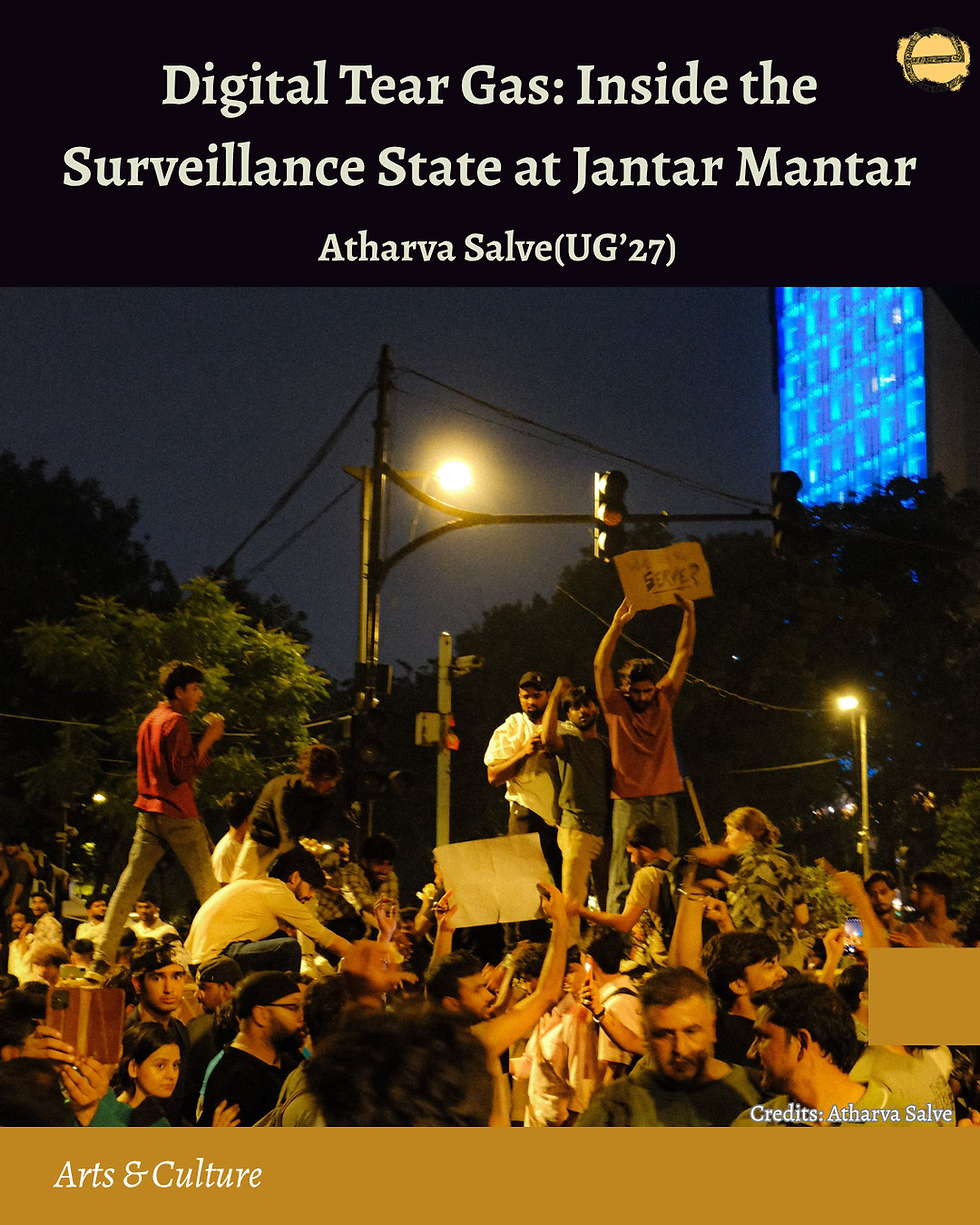
In India, through the summer of 2026, a satirical protest emerged from a single dismissive remark by the Chief Justice of India Surya Kant, who compared disaffected, unemployed youth to "cockroaches." It grew into the Cockroach Janta Party (CJP) movement, rooted in Delhi's Jantar Mantar, drawing tens of thousands into the street and surviving tear gas, electric shock devices and baton charges during an attempted march on Parliament before ultimately forcing the resignation of the education minister over an exam-paper-leak scandal. In light of youth agitation in India, both the ruling party and the opposition have noticed the Gen Z and their demands - with many opposition parties having previously endorsed the CJP protest. The aesthetics of these youth demonstrations are important, they’re methodologically and discursively turning towards unconventional, unique channels to express discontent and opposition - whether it is through reclamation of the “cockroach” insult or through a unique gathering for a shamanic ritual.

Indonesia's protest reminds me of some similar patterns of youth frustration as Nepal, Bangladesh, and India. The "Gen-Z"s are frustrated and aware of those who hold power above them, and this power gets contested, reshaped and reimagined in the streets through direct and unconventional confrontations. The protesting Gen-Zs don't wait for elections to see change - they look for mediums and trigger points : Bangladesh had a social media ban, Indonesia had a massive budget cut in education and infrastructures, and India had a NEET paper leak.

Politics in India, Indonesia, Bangladesh and Nepal is under disruption by politically under-represented, overlooked and frustrated youth confronting their governments right in the streets through a politics of visibility - through protests, memes, artworks, and at times through shamanic ritual(s) like the one I got to witness. This youth offers the world an insight and hope into what happens when power is forced to bend.

References
Agus Trihartono, "Shaman and Politics in Indonesia," Kyoto Review of Southeast Asia. https://kyotoreview.org/issue-12/shaman-and-politics-in-indonesia/
"Spirits Called To Protest Bush Visit To Indonesia," WFMY News 2. https://www.wfmynews2.com/article/news/spirits-called-to-protest-bush-visit-to-indonesia/83-403162159
"Growing discontent with policymaking keeps Indonesian students on streets," Asia News Network / The Jakarta Post. https://asianews.network/growing-discontent-with-policymaking-keeps-indonesian-students-on-streets/
"Students' Strategy to Build Protests Against Prabowo Administration," Tempo. https://en.tempo.co/read/2112495/students-strategy-to-build-protests-against-prabowo-administration
Budi Satriawan and Yuddy Cahya Budiman, "Students lead 'Dark Indonesia' protests against budget cuts," Reuters, via Yahoo News. https://www.yahoo.com/news/students-lead-dark-indonesia-protests-100002200.html
"Indonesia accepts protesters' demand to cut lawmakers' perks amid unrest," Deccan Herald. https://www.deccanherald.com/amp/story/world%2Findonesia-accepts-protesters-demand-to-cut-lawmakers-perks-amid-unrest-3705482
"Relative Deprivation Triggers Gen Z Protests, UGM Professor Explains," Universitas Gadjah Mada. https://ugm.ac.id/en/news/relative-deprivation-triggers-gen-z-protests-ugm-professor-explains/
"Nepal's prime minister resigns after protests against corruption and social media ban," NPR. https://www.npr.org/2025/09/09/nx-s1-5534953/nepal-social-media-ban-protests
"Bangladesh: Prime Minister Hasina Resigns amid Mass Protests," Human Rights Watch. https://www.hrw.org/news/2024/08/06/bangladesh-prime-minister-hasina-resigns-amid-mass-protests
"'Cockroach Janta Party': Top Indian judge's comment sparks satire, protest on social media," Al Jazeera. https://www.aljazeera.com/features/2026/5/20/cockroach-janata-party-top-indian-judges-comment-sparks-satire-protest
"'Completely Misquoted': CJI Surya Kant Says His Cockroach Remarks Were Never About the Youth," The Wire. https://m.thewire.in/article/law/completely-misquoted-says-cji-surya-kant-on-his-cockroach-remarks
"The rise of the cockroaches! How CJI Surya Kant's remark led to massive student movement at Jantar Mantar," Deccan Herald. https://www.deccanherald.com/india/the-rise-of-the-cockroaches-how-cji-surya-kants-remark-led-to-massive-student-movement-in-jantar-mantar-4081727
All Images by Atharva Salve
[Edited by Aishani Misra and Maya Ribeiro]


Comments